
Watch the person in the booth at the end of a coaster station. They glance down the train, raise a thumb, press something, and several tonnes of steel and passengers roll away. So is that the driver? Could they, on a bad day, send you into the train in front?
The short answer: no. A roller coaster is run by an industrial computer called a PLC, which reads every sensor on the ride many times a second and decides for itself whether brakes may open, motors may turn and trains may leave. The operator asks; the control system decides, and it is built so that any doubt, fault or silence ends with the ride stopped.
The rest of this piece is about how a machine earns that sort of trust: what it senses, how it thinks, why it distrusts its own wiring, and where the humans still fit in.
Sense, decide, act
Strip away the theming and every ride control system is the same three-part loop. Inputs tell the controller what is true right now: where each train is, whether every restraint is locked, whether there is air in the brake system, how hard the wind is blowing, whether anyone has hit an emergency stop. Logic compares that picture with a set of rules. Outputs carry out the result: open this brake, run that motor, unlock those gates.
The loop runs continuously. A PLC works in scans, reading every input, running the whole program and updating every output, then starting again, typically many times a second. Nothing in the program waits for a human to notice something.
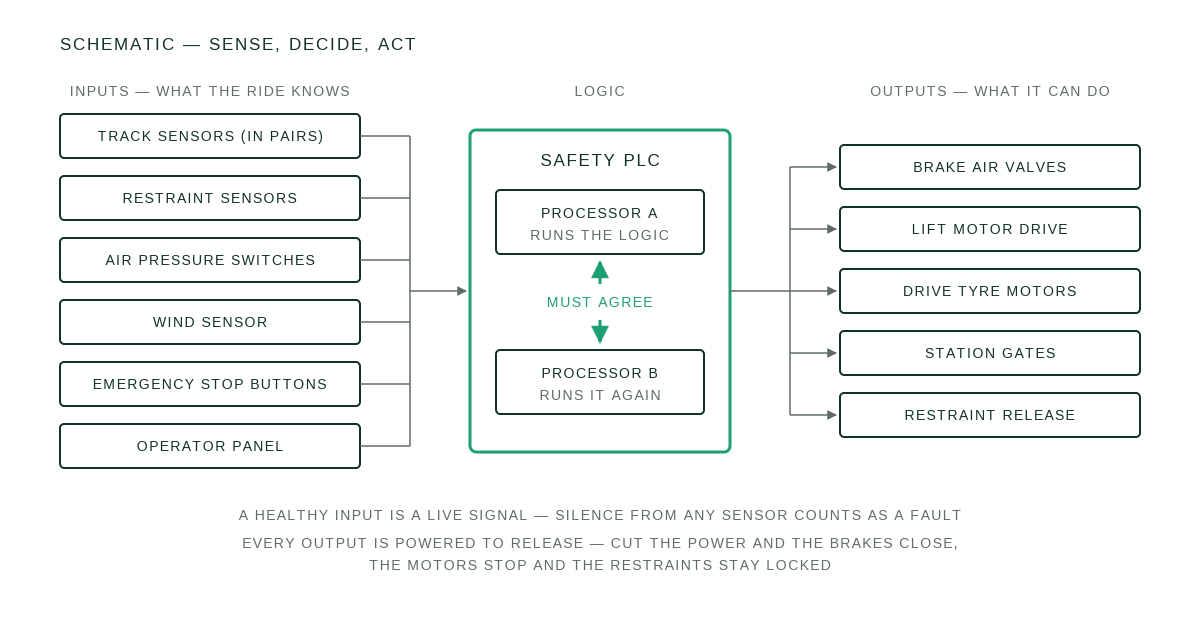
Notice where the operator’s panel sits in that drawing: on the left, among the inputs. A button press is one more piece of information for the controller to weigh, ranked no higher than a proximity sensor on the brake run.
The PLC: a computer built to be dull
PLC stands for programmable logic controller. It is a ruggedised industrial computer, the same family of machine that runs bottling lines and baggage systems, designed to do one fixed job for decades in a hot cabinet without being rebooted, updated or asked to open a spreadsheet.
Before PLCs, rides were controlled by relay logic: banks of electromechanical switches wired together so that the wiring itself was the program. It works, and plenty of older rides still carry some, but it ages badly. When the Hurricane coaster moved from the Santa Cruz Beach Boardwalk to Western Playland in New Mexico, the integrator who rebuilt its controls described a 1992 relay system full of intermittent faults nobody could trace, with obsolete parts being bought second-hand. Writing in Automation World, he said the replacement PLC now decides whether each train may advance into the next zone and shuts the ride down if a brake fails to report that it has applied.
Modern coasters go a step further and use a safety PLC, a controller designed and certified so that its own internal failures are detected. The classic arrangement is two processors running the same logic and comparing answers; some designs get the same result by running the program twice in differently coded forms and checking that the two agree. Either way, a disagreement is treated as a fault, and a fault means stop. Siemens describes its fail-safe SIMATIC controllers as meeting SIL 3, the third of four “safety integrity levels” in the functional-safety standard IEC 61508, and Rockwell’s GuardLogix range is the other name you will see on coaster cabinets.
Who writes the program varies. Some manufacturers do it in-house; others hand it to a specialist. Park World reported in 2017 that Irvine Ondrey Engineering, a small Michigan firm, was the control provider for all four coasters RMC was building for 2018, Steel Vengeance at Cedar Point among them. The name on the train is not always the name on the software.
How the track feels a train go by
A coaster has no GPS and, on most rides, no continuous knowledge of where a train is. What it has is a series of checkpoints.
The workhorse is the inductive proximity sensor: a threaded metal barrel, roughly the size of a marker pen, containing a coil that generates a small oscillating magnetic field. Bring a piece of metal close and eddy currents form in it (the same effect that slows a train on magnetic brakes), which drains energy from the coil. The sensor notices and switches. There is no contact, no moving part, and nothing for rain or grease to jam, which is precisely why the industry likes them. The same Automation World account notes that capacitive sensors were tried on the Hurricane first and would not detect the cars consistently; inductive ones did.
The target is usually a steel flag bolted under the train. As it passes over a sensor, the controller sees a pulse and learns three things: a train is here, it arrived at this moment, and, from how long the pulse lasted or how soon the next sensor fired, how fast it is going.
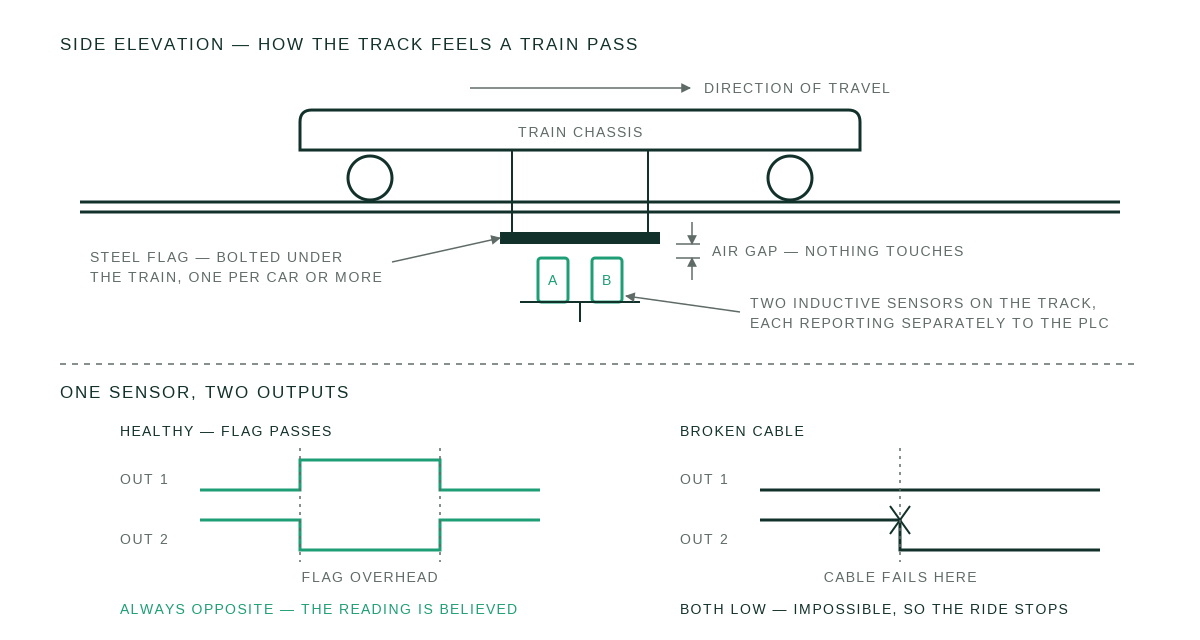
Sensors cluster where decisions are made: either end of every brake run, the top and bottom of the lift, the station, and the entry to each launch track. Those clusters are what turn a length of track into a block, and they are the eyes of the one-train-per-block rule that keeps trains apart.
Why the computer distrusts its own sensors
A sensor that reads “nothing here” is ambiguous. Perhaps there is no train. Perhaps the cable has been chewed through. A control system that cannot tell those apart is useless, so a great deal of the engineering goes into making failures visible.
Pepperl+Fuchs, the German sensor maker, has published a neat example in a case study of a Gerstlauer Euro-Fighter it equipped. The sensors have antivalent outputs: two signal wires that are always opposite, one on whenever the other is off. A passing flag flips both. A broken wire, a short circuit or a dead sensor leaves both in the same state, which can never happen legitimately, so the controller knows instantly that it is looking at a fault and not at an empty track. On that ride the sensors are also fitted in pairs and read redundantly by the safety PLC.
The same case study lists two more layers. A separate speed monitor in the cabinet checks vehicle speed independently of the main controller, and each car carries a transponder, a small radio tag, that a reader uses to count vehicles past a point. A train that sheds a car, or a car that turns up where it should not be, does not go unnoticed.
Then there is time. The controller knows roughly how long a train takes between checkpoints. If a train leaves one sensor and fails to reach the next within its window, the logic does not assume it is merely late. It assumes a train is stopped somewhere on the circuit, holds everything behind it, and tells the operator. That is how a ride learns it has a train stranded in a valley, the situation covered in our report on the Minifigure Speedway stall at Legoland Billund.
| What is watched | Typical sensor | What a bad or missing reading does |
|---|---|---|
| Train position and speed | Paired inductive proximity sensors | Blocks behind are held; brakes stay closed |
| Restraints | A sensor on every lap bar or harness | Dispatch refused |
| Brake position | Sensors on each caliper | Ride stops if a brake fails to confirm |
| Air supply | Pressure switches | Brakes close by themselves; no dispatch |
| Lift or launch | Motor drive feedback, chain or cable sensors | Lift stops; launch aborted |
| Wind | Anemometer on the structure | No new dispatches above the limit |
| Emergency stops | Dual-channel buttons | Power removed from every output |
The dispatch rung
Engineers traditionally draw control logic as ladder logic, a notation inherited from relay wiring diagrams. Each rung of the ladder is a row of conditions in series, with an action at the far end. Current only reaches the action if every condition along the rung is true.
Sending a train is one of those rungs. The block ahead must be clear. Every restraint must report locked. The station gates must be shut, the air pressure healthy, the emergency stops untripped. Only then does the last condition matter: the operators’ buttons.
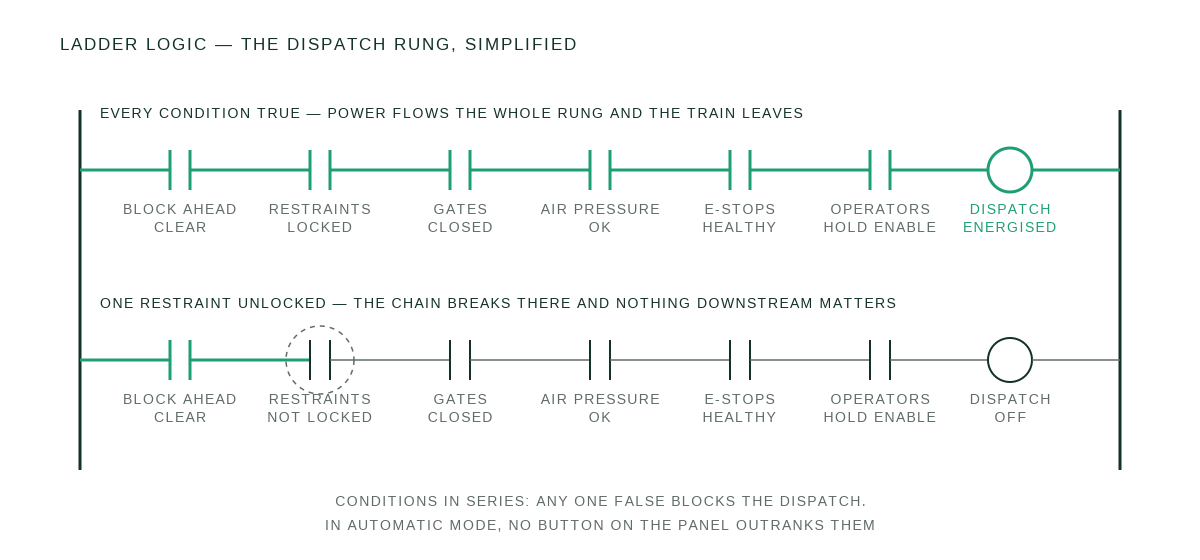
On most large coasters, dispatch is not one button but several. Each platform attendant has an enable button at their position, and the train will only go if all of them are held at the same moment as the main dispatch button. It is a simple way of proving that every person on the platform is standing at their post, hands occupied, and agrees the train is ready. It also explains the slightly ceremonial pause before a train leaves: you are watching three people complete a circuit.
This is also where a ride’s capacity is won or lost. The control system will accept a dispatch the instant the rung is complete. Everything slower than that is people and loose bags.
Fail-safe from the cabinet outwards
The rule that governs the outputs is the one that governs the brakes themselves: energy to release, never to apply. Brake calipers are sprung shut and held open by air; the valves that admit the air are held open by an electrical signal. The controller therefore has to keep actively asserting “open” for a brake to stay open. Stop the signal for any reason, a tripped breaker, a cut cable, a crashed processor, and the valve drops out, the air vents and the springs do the rest.
The emergency stop exploits this directly. The red mushroom buttons on the panel and around the station are wired on two separate channels, and pressing one takes the power away from the outputs. What an E-stop does not do is freeze trains in mid-air, whatever the name suggests. A train already out on the circuit rolls on to the next brake run and is held there, because a brake run is the only place a coaster can be stopped safely and evacuated from a walkway.
Modes, keys and the human in the loop
In normal running the ride sits in automatic mode, and the operator’s panel is deliberately sparse: dispatch, restraint lock and release, gates, a ride stop and an emergency stop. Everything else belongs to the controller.
Turning a key switch moves the ride into a manual or maintenance mode, where an engineer can drive individual brakes, tyres and motors to move a train by hand: on to the transfer track, off a brake run after a fault, around for testing. The key matters. It is how the system knows the person at the panel is someone trained and authorised to take decisions the logic would normally make.
It is also the point where the machine’s guarantees give way to procedure. When The Smiler crashed at Alton Towers in 2015, the Health and Safety Executive found nothing wrong with the control system; it had correctly detected a stalled train and stopped the ride, and engineers then overrode it. Every well-run park now treats a mode key as a controlled item, and resetting a fault as a decision that needs a reason, a second person and eyes on the track. Checking that those sensors and interlocks behave as designed is part of the daily inspection routine before a single guest boards.
Where you’ll find it
Everywhere, is the honest answer, but some places let you see it:
- The booth. Look for the key switch, the mushroom-headed emergency stop and the row of lit buttons. A flashing dispatch button generally means the rung is complete and the ride is waiting for the humans.
- The brake run. The small barrels on brackets beside the rails, each with a cable tail, are the proximity sensors. They tend to come in twos.
- Gerstlauer’s Euro-Fighter. The installation in the Pepperl+Fuchs case study uses the paired antivalent sensing described above, plus the independent speed monitor and the transponder count. That is the supplier’s own account of one ride, so treat it as a worked example, not a census.
- The 2018 RMC class, including Steel Vengeance at Cedar Point, run on control systems from an independent specialist, a reminder that controls are a trade of their own.
The Dispatch verdict
What is clever about a ride control system is how little it trusts. It does not trust the operator’s judgement of whether the block is clear, the sensor’s word that nothing is there, the cable carrying that word, or even its own processor, and for each of those doubts there is a specific piece of engineering: an interlock, a second wire, a paired sensor, a second calculation.
The result is a machine whose every uncertainty resolves the same way, with a train parked on a brake run and a mildly bored announcement about a technical delay. That is not the system failing. That is the system working, in the only way it can let you see.
Further reading: how block systems keep coaster trains apart, how coaster brakes are built to fail closed, how restraints lock and report to the controller, and what a launch track adds to the control problem.